Seafarer's Reef
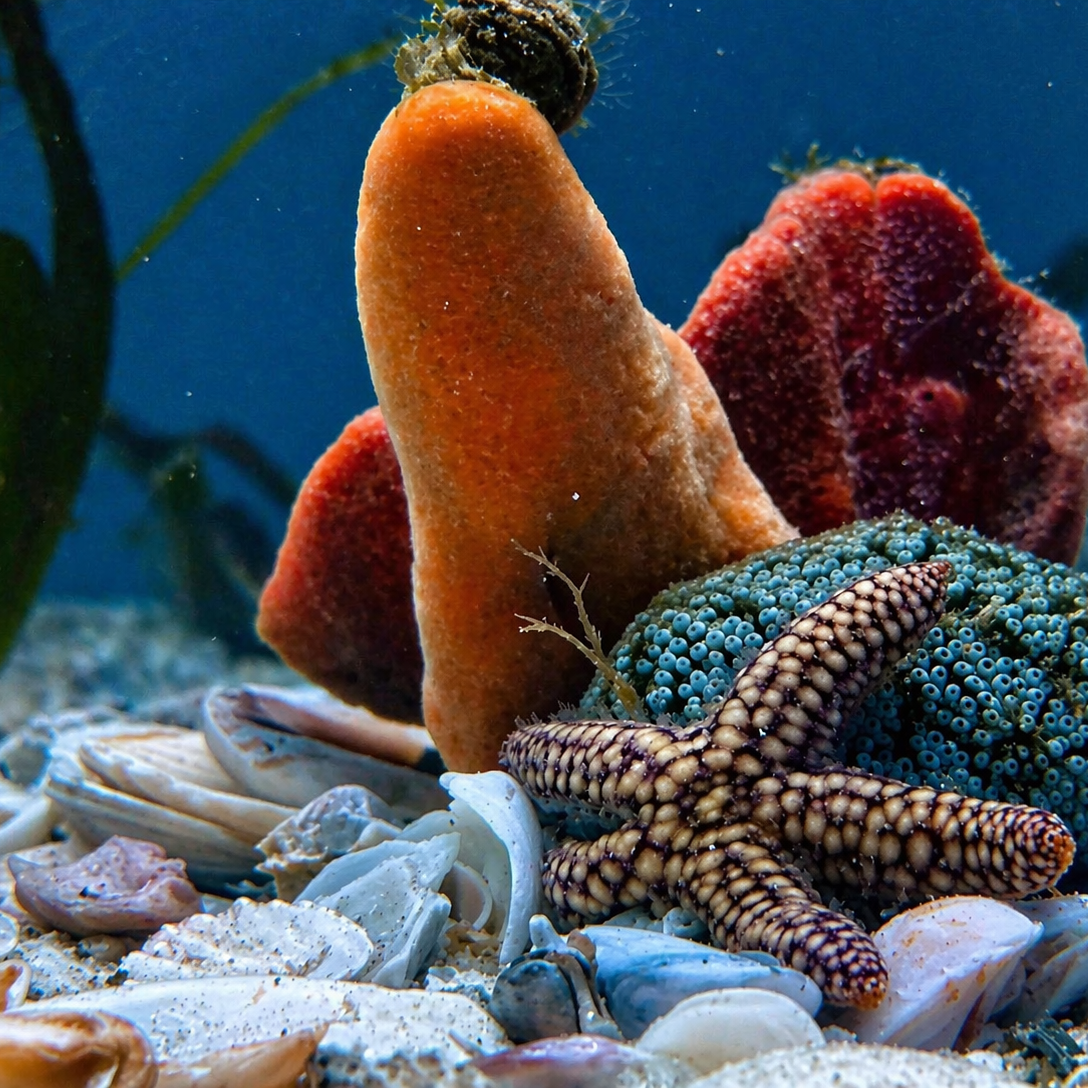
Spiny Starfish (Echinaster spinulosus)
Spiny Starfish (Echinaster spinulosus)
Couldn't load pickup availability
A hardy asteroid echinoderm with elongated, tapering arms and a flexible body adapted for navigating complex reef surfaces. Its exterior is covered in fine calcareous spines, giving it a slightly textured appearance while maintaining a soft, almost elastic form compared to more rigid sea stars. Coloration typically ranges from orange to reddish hues, often shifting subtly depending on diet and environment.
In the wild, Echinaster spinulosus inhabits reef margins, rocky outcrops, and seagrass-adjacent substrates, where it functions as a slow but constant benthic grazer. It feeds across surfaces, consuming biofilms, microbial mats, encrusting organisms, and detrital material, playing a direct role in nutrient recycling and surface conditioning.
Cultivation & Condition
Specimens are raised within sunlit, outdoor systems, developed as self-sustaining ecosystems rather than sterile holding environments. Continuous exposure to natural light cycles, diverse microfauna, and stable nutrient exchange produces individuals that are biologically “settled” rather than recently stressed or imported.
- Maintained under full-spectrum natural sunlight
- Conditioned in stable, biologically active systems
- Actively feeding at time of selection
- No signs of tissue recession or structural damage
These conditions result in sea stars that exhibit consistent grazing behavior immediately upon introduction, rather than requiring extended recovery periods.
Behavior & Ecological Role
- Slow, continuous surface grazing via tube feet
- Targets microbial films and organic accumulation
- Contributes to substrate cleanliness and nutrient turnover
A healthy individual will remain in near-constant motion, methodically working across rock surfaces without long periods of inactivity.
Notable biological trait:
Echinaster spinulosus possesses a decentralized physiological structure typical of echinoderms, allowing for localized regeneration of damaged tissue. Under stable conditions, partial arm loss can be recovered over time, supported by its distributed organ systems.
Aquarium Integration
- Thrives in established systems with mature biofilms
- Requires stable parameters and consistent conditions
- Benefits from complex rockwork with ample surface area
This species functions as a living extension of the benthic ecosystem, actively interacting with microbial layers that define long-term system stability. It is not a passive display organism, but a continuous processor of organic material within the environment.
Share