Seafarer's Reef
Halophila engelmannii - Star Grass
Halophila engelmannii - Star Grass
Couldn't load pickup availability
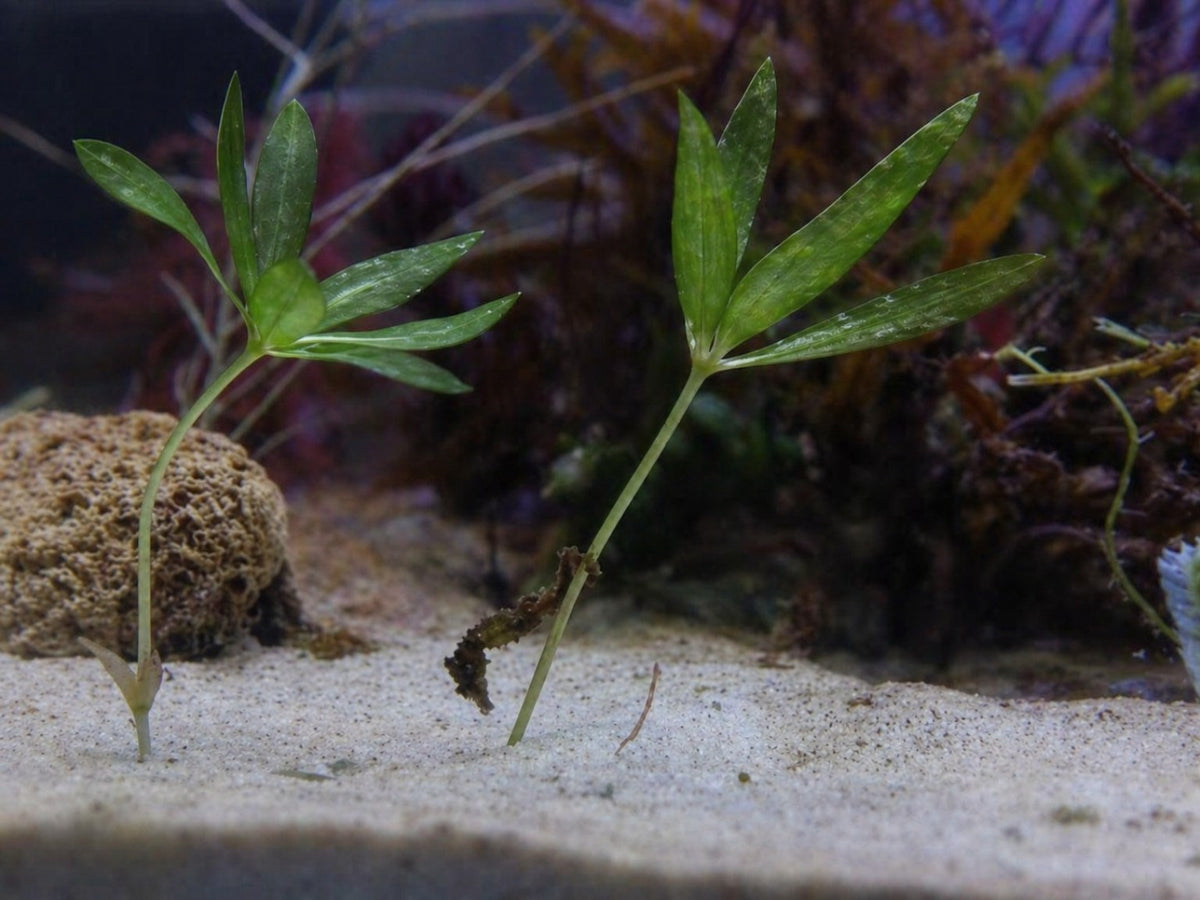
A particularly unique and less commonly encountered seagrass, Halophila engelmannii is immediately recognizable by clusters of small leaves arranged in distinctive star-like whorls. Rather than producing the long blades associated with turtle or manatee grass, Engelmann’s grass develops compact shoots connected by thin, creeping rhizomes beneath the substrate. The result is a miniature underwater meadow with an appearance unlike almost any other marine plant.
This is one of Florida’s more unusual native seagrasses. Its small stature allows it to grow beneath taller seagrasses as an understory species, and it is remarkably well adapted to lower-light environments. Populations can occur considerably deeper than many of the larger meadow-forming seagrasses, demonstrating just how efficiently this plant can utilize available light.
Cultivation & Condition
Our Engelmann’s grass is a special aquacultured offering grown within our own mature marine systems. Because of its relatively delicate structure and unusual growth form, established specimens are carefully selected from healthy, actively spreading populations.
- 100% aquacultured within our own systems
- Grown within mature, high-biodiversity marine ecosystems
- Established under natural sunlight and biologically active conditions
- Selected with healthy leaves, roots, and intact creeping rhizomes
- Carefully handled due to its naturally delicate growth structure
- One of our more specialized seagrass offerings
Our populations grow alongside the microorganisms, microfauna, algae, invertebrates, and other biological components of an established marine ecosystem. This provides a biologically complex environment from the beginning rather than attempting to establish the plant under sterile conditions.
Ecological Role
- Forms a low-growing seagrass understory across suitable substrate
- Creeping rhizomes help bind and colonize marine sediments
- Provides miniature habitat and additional surface area for microfauna
- Fixes carbon and produces oxygen through photosynthesis
- Can occupy lower-light environments than many larger seagrasses
Notable Biological Trait
The architecture of Halophila engelmannii is what makes it exceptional. Individual shoots commonly terminate in a whorl of several small leaves, creating the characteristic star-shaped pattern responsible for the common name “star grass.” Beneath the sediment, these individual stars are connected by slender rhizomes, meaning what appears to be a collection of tiny independent plants can actually be part of a larger interconnected clone.
Its ability to tolerate comparatively low light is another remarkable adaptation. Engelmann’s grass has been documented growing at substantial depths and can occupy the understory beneath larger seagrasses where available light is considerably reduced.
Like other true seagrasses, this seemingly simple organism is also a flowering plant. It possesses roots, vascular tissue, flowers, pollen, seeds, and creeping rhizomes, completing its entire life cycle while submerged in seawater.
Aquarium Integration
- Best suited for mature aquariums with stable conditions
- Requires fine, stable substrate for its delicate rhizome network
- Should be handled carefully during planting and transplantation
- Can gradually spread horizontally once successfully established
- Excellent choice for specialized seagrass biotopes and natural marine displays
Halophila engelmannii offers something completely different from the towering blades of conventional seagrasses. Its miniature star-shaped shoots create a detailed living carpet across the substrate, while an almost hidden network of roots and rhizomes expands underneath. For aquarists building a true seagrass ecosystem, Engelmann’s grass adds another biological layer that few marine aquariums ever contain.
Share