Seafarer's Reef
Astrophyton muricatum - Atlantic Giant Basket Star (EXPERT ONLY)
Astrophyton muricatum - Atlantic Giant Basket Star (EXPERT ONLY)
Couldn't load pickup availability
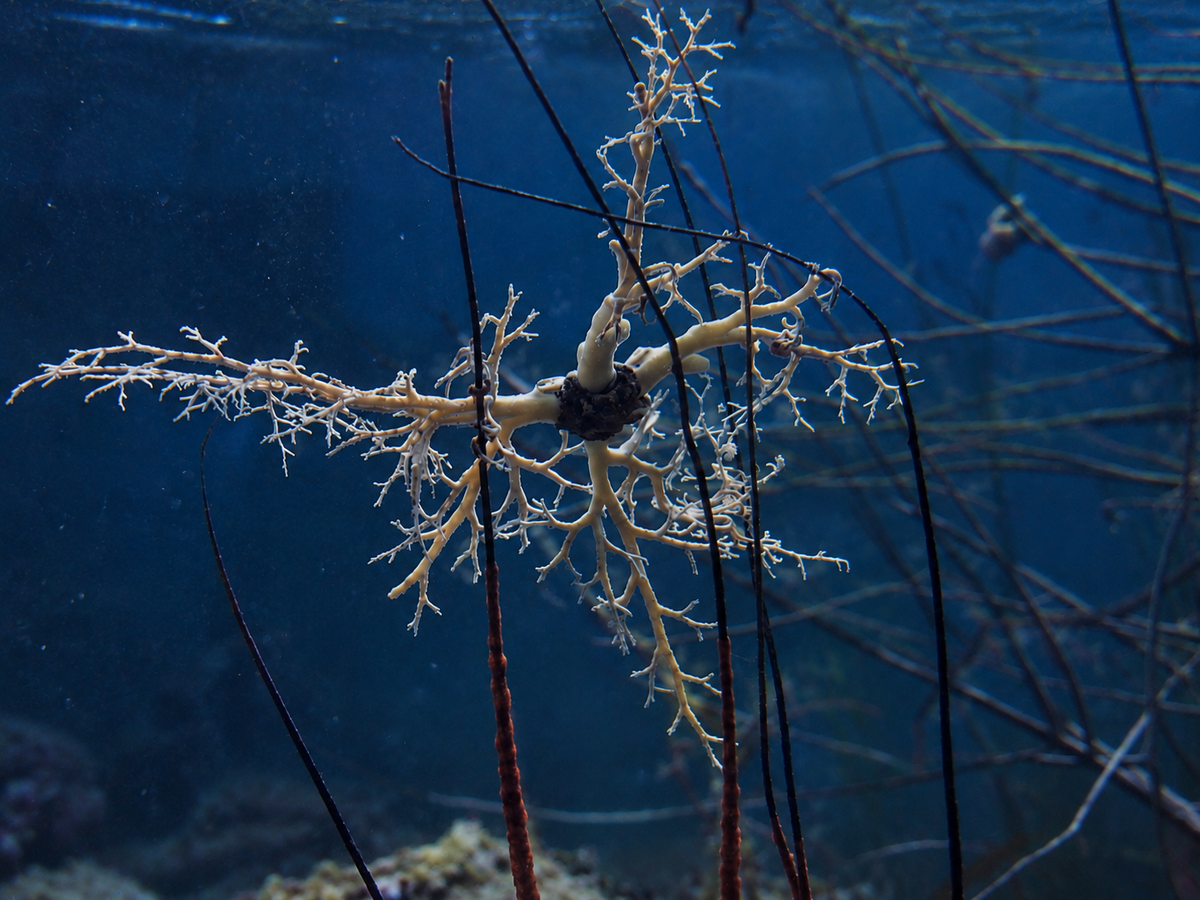
One of the most extraordinary echinoderms of the western Atlantic, Astrophyton muricatum is a large basket star distinguished by five primary arms that repeatedly divide into hundreds of increasingly fine branches. When fully extended, these branches form an intricate living net capable of spanning an impressive area. Despite the common name “basket starfish,” this species is actually an ophiuroid, making it more closely related to brittle stars than to true sea stars.
Its appearance is matched by an equally unusual feeding strategy. Rather than crawling across the substrate in search of food, A. muricatum climbs onto elevated structures and unfurls its branching arms into moving water. Tiny hooks along the arms intercept zooplankton, including copepods and invertebrate larvae, which are then transferred toward the central mouth. In nature, this behavior occurs primarily at night, while the animal typically remains tightly coiled and sheltered during daylight hours.
Cultivation & Condition
Our Atlantic basket stars are fully aquacultured and maintained within mature, high-biodiversity marine ecosystems. They are conditioned alongside the diverse microorganisms and invertebrate life characteristic of our established systems rather than being kept as short-term display animals.
- 100% aquacultured within our own systems
- Maintained in mature, high-biodiversity marine ecosystems
- Carefully selected for intact arms and healthy responsiveness
- Observed for normal extension and feeding behavior
- Conditioned within stable, biologically active water
Feeding & Behavior
- Suspension feeder specialized for capturing zooplankton
- Extends its branching arms into current to form a living feeding net
- Typically becomes most active after dark
- Uses elevated structures as feeding perches
- Rapidly coils its arms in response to disturbance
The transformation between resting and feeding behavior is remarkable. A tightly folded individual can gradually unfold into an elaborate three-dimensional network of branching arms, dramatically increasing the area available for intercepting passing prey. Field observations have documented strong site fidelity, with individuals repeatedly using established locations for feeding.
The regenerative capabilities of this species are exceptional. Smithsonian aquarists documented an A. muricatum spontaneously dividing through its central disc, after which both portions survived, continued feeding, and regenerated. It was the first documented case of this form of asexual reproduction in the species.
Aquarium Integration
- Requires consistent access to appropriately sized suspended foods
- Benefits from moderate water movement for suspension feeding
- Requires branching rockwork or similar elevated structures for perching
- Best suited to established systems with highly stable water conditions
- Delicate branching arms should be protected from aggressive tankmates and mechanical damage
With its nocturnal behavior, extreme arm branching, and specialized plankton-capture strategy, Astrophyton muricatum is one of the closest things the Atlantic has to a genuinely alien-looking reef organism. A fully extended specimen provides a rare opportunity to observe a feeding architecture that looks almost engineered for the sole purpose of extracting microscopic life from moving seawater.
Share